Trajectory Planner for Autonomous Ground Vehicles in Unknown Environments
Jul 13, 2024
·
2 min read
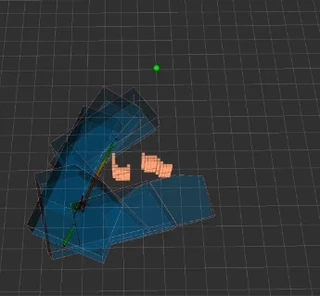
Developed a comprehensive autonomous navigation stack for ground vehicles as part of my Master’s thesis, extending FASTER with a new trajectory planner, a novel recovery behavior, and MPC-based feedback control.
Key Contributions:
- Trajectory Planning: Replaced FASTER’s JPS-only planning approach with Hybrid A* as the primary trajectory planner, supplemented by JPS to improve planning efficiency, reducing optimization failures and total simulation time.
- Free Space Estimation Recovery Behavior: Designed and implemented a novel free-space estimation approach that acts as a recovery behavior in critical situations, particularly narrow paths and corridors where nominal free-space estimation tends to fail.
- Feedback Control: Integrated Model Predictive Control (MPC) as the vehicle’s feedback control mechanism, enabling precise real-time trajectory tracking toward the optimal path.
Methods Used:
- Hybrid A* trajectory planning, supplemented by Jump Point Search (JPS)
- Novel free-space estimation recovery behavior for narrow-space navigation
- Model Predictive Control (MPC) for feedback control
- Simulation-based validation against baseline planners (FASTER/JPS-only, Hybrid A*-only)
Software Used: ROS, C++, Gurobi Optimizer, Gazebo, Rviz, JPS3D
Results (validated in simulation):
- 23% reduction in optimization failures compared to the original FASTER approach (JPS-only planning)
- 3% reduction in total simulation time compared to using Hybrid A* alone
- 5x improvement in recovery success rate over nominal free-space estimation in obstacle-dense, narrow-corridor environments
This video shows the mobile robot navigating to a random target point (green sphere) while avoiding new obstacles in the unknown environment.

Authors
Senior Software Engineer
Software Engineer with 3 years of experience developing perception and autonomy systems for
UAVs operating in GPS-denied environments. Strong background in deep learning (PyTorch), reinforcement learning, and real-time C++/Python systems deployed on embedded edge platforms. My
expertise lies in translating complex research results into robust, production-ready software solutions.