Human Iris Detection
Dec 1, 2021
·
1 min read
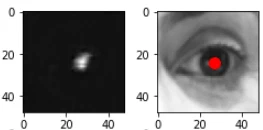
Implemented a CNN-based pupil localization pipeline in Python, reproducing the methodology from the paper “Accurate Eye Pupil Localization Using Heterogeneous CNN Models”.
Key Contributions:
- Model Implementation: Reproduced a heterogeneous CNN architecture for pupil detection, adapting the paper’s design to a practical Python/PyTorch workflow.
- Data Pipeline: Built preprocessing and augmentation routines to prepare eye image datasets for training and evaluation.
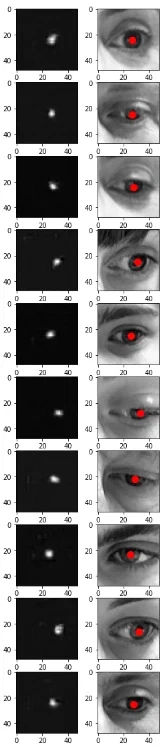
- Evaluation: Tracked train/test loss across training and validated predicted vs. ground-truth iris centers on held-out test images.
Methods Used:
- Dilation and Gaussian blurring for target (label) preprocessing
- Convolutional autoencoder as the model architecture
- Grid search across optimizers, loss functions, and activations to find the best combination:
- optimizers: [SGD, Adam, Adamax, RMSprop]
- loss functions: [MSE, MAE]
- activations: [Tanh, ReLU, Sigmoid]
- best combination found: Adam + MSE + Tanh
Software Used: OpenCV, PyTorch, NumPy, Pandas, scikit-learn
Sample Result:
These images show the heat map and predections generated by the model.

Authors
Senior Software Engineer
Software Engineer with 3 years of experience developing perception and autonomy systems for
UAVs operating in GPS-denied environments. Strong background in deep learning (PyTorch), reinforcement learning, and real-time C++/Python systems deployed on embedded edge platforms. My
expertise lies in translating complex research results into robust, production-ready software solutions.